Cenote Azul: Bacalar’s Deep Blue Secret

Some places are known for their beauty. Others, beautiful as they are, also seem to hold a story.
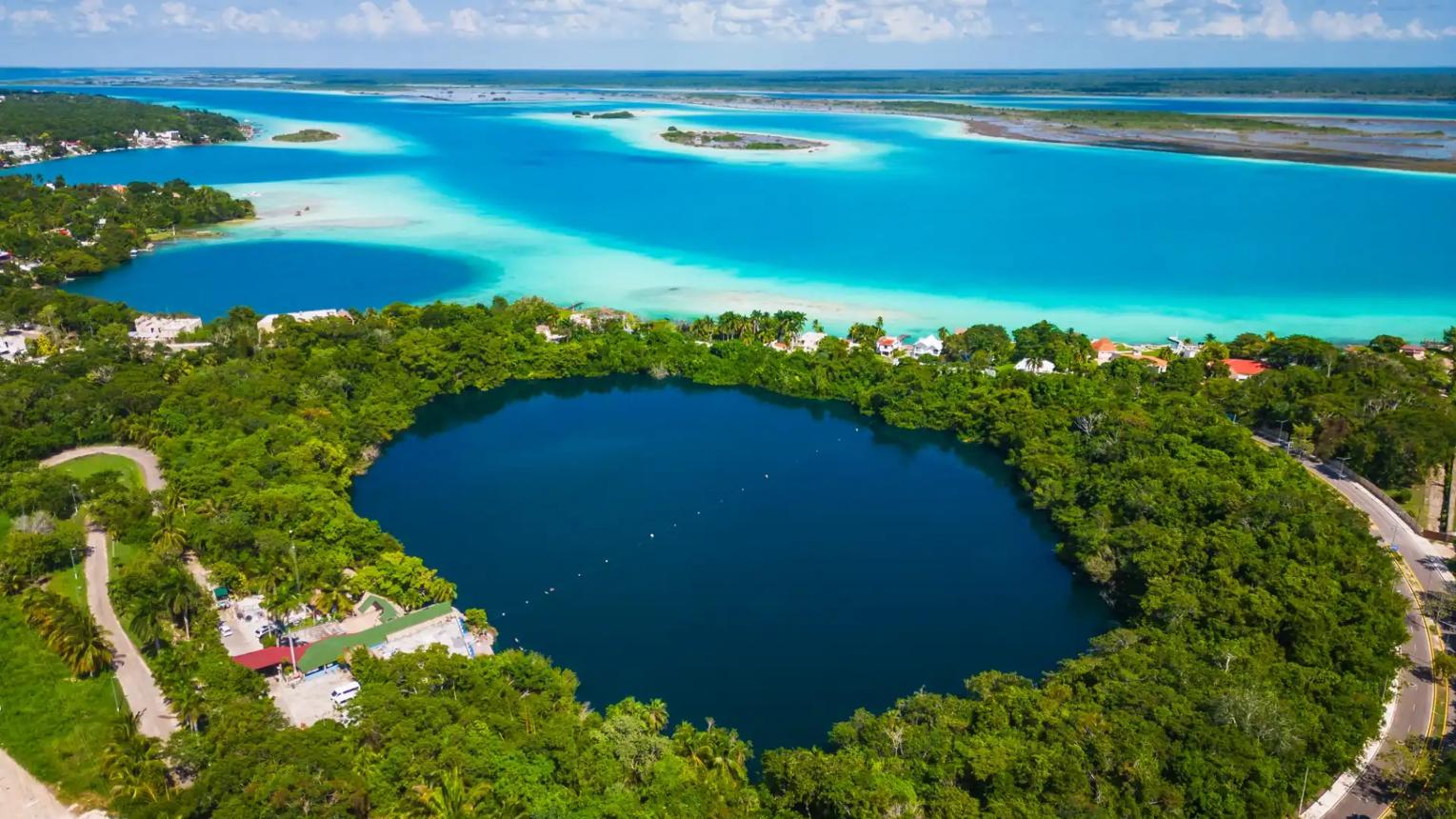
Just a few minutes from downtown Bacalar lies Cenote Azul, a body of water that stands in striking contrast to the region’s best-known image: the vast turquoise surface of the Lagoon of Seven Colors. While the lagoon stretches toward the horizon, the cenote invites you to look in another direction: downward, into the depths.
A Different Kind of Blue
The name sounds simple, but it is hard to imagine a color that could truly do it justice.
Cenote Azul stands out for the intense deep-blue hue of its water and for its depth. Unlike the shallow waters found in some parts of the lagoon, here the scenery changes dramatically.
The surface may seem calm, even serene. But beneath it lies a much deeper world.
At more than 90 meters deep, Cenote Azul is considered one of the deepest cenotes on the Yucatán Peninsula. Its origins are tied to the region’s characteristic karst landscape, where water has shaped limestone over thousands of years.
It is precisely this combination of geology, water, and light that gives the cenote its distinctive character.
A Natural Landscape Before a Tourist Attraction
In Bacalar, it is easy to think of the lagoon first. Its seven shades of blue dominate almost every image used to represent the destination.
But Cenote Azul tells another part of the region’s natural story.
Cenotes are among the most fascinating features of the Yucatán Peninsula’s landscape. Some are open to the sky, others are partly covered, and still others form entire underground worlds.
Cenote Azul belongs to a particularly special category: a broad expanse of open water surrounded by tropical vegetation, where the sense of depth begins almost at the shoreline.
The experience is almost contradictory. The surroundings feel peaceful, yet the water constantly reminds you that you are standing beside an extraordinarily deep natural formation.
A Place to Observe, Swim, and Explore
For years, visitors and Bacalar residents alike have known Cenote Azul as a place to swim and enjoy the water.
Its unusual characteristics and depth have also attracted people interested in diving.
But the place has something special about it even if you never enter the water.
Sitting beside the cenote and watching the surface change color as the sun moves is a very different experience from gazing out over the lagoon.
Here, there is no comparable sense of endless space.
The lagoon invites you to look into the distance. The cenote invites you to look into the depths.
The Maya Connection to Water
To talk about cenotes on the Yucatán Peninsula is also to talk about the ancestral relationship between Maya communities and water.
Cenotes were essential sources of fresh water in a region with few surface rivers. They also held deep cultural and spiritual significance for Maya societies.
For that reason, visiting a cenote should not be seen as merely a recreational activity. These places are part of a much broader landscape in which nature, history, and culture have been intertwined for centuries.
In Bacalar, this relationship takes on an even more interesting dimension: the town is surrounded by water in many different forms, from the lagoon to the cenotes and the underground systems characteristic of the peninsula.
Another Side of Bacalar
Perhaps one of the best reasons to visit Cenote Azul is that it reveals a different side of Bacalar.
There is the Bacalar of docks and sunrises.
There is the Bacalar of kayaks and paddleboards.
There is historic Bacalar, with San Felipe Fort and its quiet streets.
And there is this other Bacalar: deeper, quieter, and more mysterious.
Cenote Azul does not compete with the lagoon. It complements it.
After spending a morning admiring the different blues of Bacalar Lagoon, arriving at the cenote almost feels like changing scale. The open horizon gives way to a more enclosed space; clear, shallow water becomes an immense blue column disappearing beneath the surface.
A Reminder That Bacalar Is Much More Than a Lagoon
Bacalar’s international fame inevitably began with its lagoon.
But as the destination matures, new ways of understanding it are emerging.
Cenote Azul is one of them.
It is geology, water, vegetation, and memory. It is a place that needs little explanation to spark curiosity. All you have to do is look at its surface and wonder what lies below.
And perhaps that is where its charm lies.
Because in Bacalar, blue does not always mean the same thing.
Sometimes it is the color of sunlight on the lagoon.
And at other times, as at Cenote Azul, it is a doorway to depths that still invite discovery.
← View all guides